Hiring a mobile app developer in India in 2026 can cost you ₹500 an hour or ₹4,000 an hour, and both prices are fair depending on who you hire and what you’re building. The range is that wide because “app developer” covers a freelancer working evenings, a five-person studio, and a full agency with designers and testers on payroll. Each comes with its own price tag and its own set of trade-offs.
This guide lays out what each hiring option actually costs, the going hourly rates by experience level and tech stack, the difference between project, dedicated-team, and hourly engagement, and the math behind keeping a team in-house versus outsourcing.
Rates are only half the picture. What an hourly figure excludes, and how to judge whether a given number is fair, are covered further down, because a cheap rate attached to a bad arrangement costs more than an expensive one attached to a good one. For the process of finding and screening people rather than pricing them, our guide to hiring app developers in India covers that side.
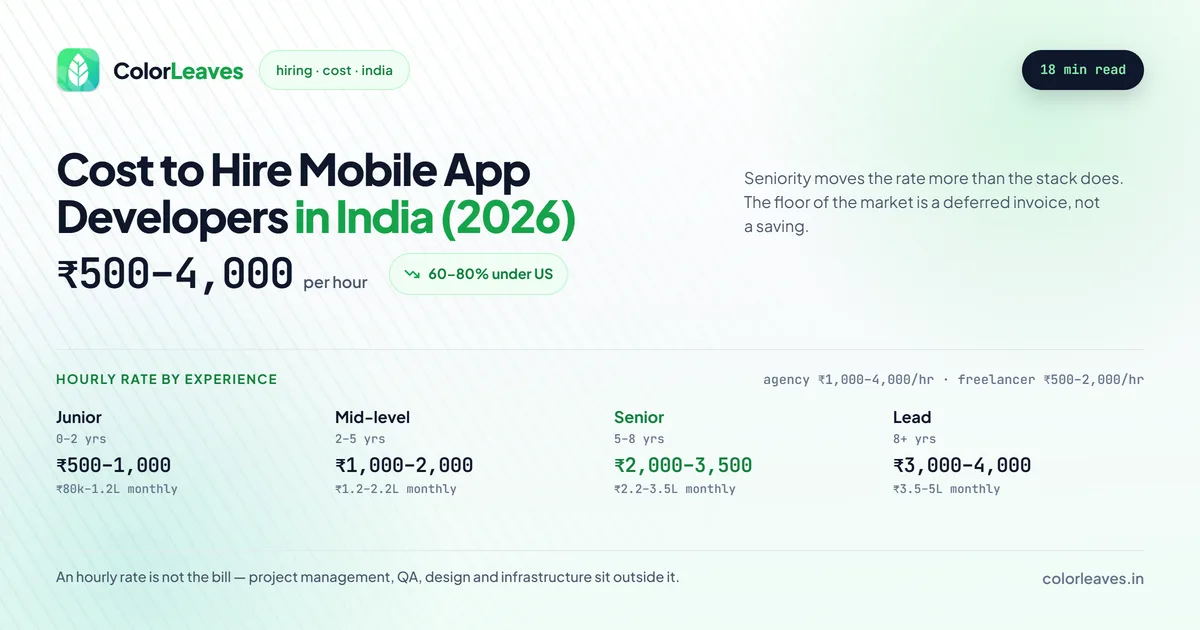
Key Takeaway: In 2026, Indian mobile app developers charge ₹500 to ₹2,000 per hour as freelancers, ₹1,000 to ₹2,500 per hour at small agencies, and ₹1,500 to ₹4,000 per hour at established companies. By experience, expect ₹500 to ₹1,000 for juniors, ₹1,000 to ₹2,000 for mid-level, and ₹2,000 to ₹4,000 for senior developers. That’s roughly 60 to 80% cheaper than hiring in the US or Western Europe.
The Three Ways to Hire App Developers
Before you look at rates, decide who you’re hiring. There are three models, and they don’t cost the same or carry the same risk.
Freelancer
A single developer you bring on directly, usually through a platform or a referral.
Pros: lowest hourly rate, direct communication, flexible hours. Cons: one person can’t cover design, development, and testing well; availability dries up when they take other work; no backup if they disappear mid-project. Best for: small apps, fixing or extending an existing app, or adding a hand to a team you already have. Cost: ₹500 to ₹2,000 per hour.
App Development Agency
A studio with developers, designers, testers, and a project manager under one roof.
Pros: full-stack coverage, defined process, someone accountable for delivery, support after launch. Cons: higher rates than a freelancer, often a minimum project size. Best for: complete apps from scratch, complex builds, and clients who want one team owning the outcome. Cost: ₹1,000 to ₹4,000 per hour, or a fixed project price.
In-House Team
Your own salaried developers, designers, and QA staff.
Pros: full control, deep product knowledge over time, instant availability. Cons: slow and expensive to hire, you pay salaries even between projects, and you carry recruitment, hardware, and office overhead. Best for: companies with a long-term product roadmap and continuous work, not a one-off app. Cost: ₹50 Lakhs to ₹80 Lakhs a year for a small team (more on this below).
| Hiring Model | Hourly Rate | Setup Time | Best For |
|---|---|---|---|
| Freelancer | ₹500 to ₹2,000 | A few days | Small apps, fixes, team top-ups |
| Agency | ₹1,000 to ₹4,000 | 1 to 2 weeks | Full apps, complex builds |
| In-House Team | Salary-based | 2 to 3 months | Long-term product work |
For a deeper look at vetting candidates and the questions to ask before signing, read our guide on how to hire the best app developer in Pune.
Indian Developer Hourly Rates by Experience
Experience moves the rate more than almost anything else. A senior developer costs three to four times what a junior does, and usually earns it by writing cleaner code, making fewer expensive mistakes, and needing far less hand-holding.
| Experience Level | Years | Hourly Rate (INR) | Monthly (Dedicated) |
|---|---|---|---|
| Junior | 0 to 2 | ₹500 to ₹1,000 | ₹80,000 to ₹1,20,000 |
| Mid-level | 2 to 5 | ₹1,000 to ₹2,000 | ₹1,20,000 to ₹2,20,000 |
| Senior | 5 to 8 | ₹2,000 to ₹3,500 | ₹2,20,000 to ₹3,50,000 |
| Lead / Architect | 8+ | ₹3,000 to ₹4,000+ | ₹3,50,000 to ₹5,00,000 |
The smart move for most projects is a mix. Put a senior developer on architecture and the tricky parts, and let mid-level and junior developers handle the routine screens. An all-senior team is rarely worth the bill.
The corollary matters more. An all-junior team at the bottom of the range is not a saving, because below a certain rate the only way anyone delivers is juniors with nobody reviewing them. What arrives runs on the developer’s machine and falls over on a three year old handset, and the bill turns up later as a rebuild. Rebuilds cost more than originals, since somebody has to understand the existing code first. A fair Indian market rate is a genuine saving. The floor of the market is a deferred invoice.
Judging seniority is harder than judging price, and it is the thing worth spending effort on. Our interview questions for mobile developers are written to be usable by somebody who cannot read code, and the trick is grading on specificity rather than correctness. Ask about a release that went wrong. Everyone who has shipped has that story ready.
Hourly Rates by Technology
Rates shift a little by platform too. iOS specialists tend to charge slightly more because the talent pool in India is smaller than the Android pool. Cross-platform developers sit in the middle and often save you money overall, since one developer builds for both platforms.
| Technology | Hourly Rate (INR) | Hourly Rate (USD) | Notes |
|---|---|---|---|
| Android (Kotlin) | ₹600 to ₹3,000 | $8 to $36 | Largest talent pool in India |
| iOS (Swift) | ₹800 to ₹3,500 | $10 to $42 | Smaller pool, slightly higher rates |
| React Native | ₹700 to ₹3,000 | $9 to $36 | JavaScript devs, good for web crossover |
| Flutter | ₹700 to ₹3,000 | $9 to $36 | Fast-growing, strong for custom UI |
If you’re building for one platform first, Android development usually gives you the widest reach in the Indian market and the deepest hiring pool. If you want both Android and iOS from a single codebase, cross-platform development with React Native or Flutter cuts your developer count and your bill by 30 to 40%. Our comparison of which platform to launch first covers when Android-first is wrong, which is mainly when your users or your revenue are American, and choosing a mobile platform covers the wider decision.
Rates in that table are not the whole story on stack either. React Native has a hiring advantage that never shows up in a price column: if you already employ React web engineers, they can review the mobile work, which removes most of the usual risk of an outside hire. Our page on hiring React Native developers covers that, alongside Android and iOS for the native routes. Flutter benches in India run deeper than most overseas teams expect, so those roles fill faster here than the rate suggests, and Flutter versus React Native covers the technical side of the choice.
What an Hourly Rate Does Not Include
The number people compare is a developer’s hourly rate. The number they pay is not the same, and the gap is where quotes stop being comparable.
Non-billable time is real. A developer does not spend eight hours a day writing your features. Standups, code review, planning, answering your questions and fixing their own bugs all consume the day. Some firms bill for it, some absorb it into a higher rate. Neither is wrong. Comparing one against the other on rate alone is.
Project management is usually a separate line. For an agency engagement this typically runs 10 to 15 percent of development hours, and it buys somebody making sure the right thing gets built. Worth having. Worth knowing you are paying for.
QA is not free. A build with no dedicated testing has cheaper hours and more expensive months. Ask whether the quote includes testing across a device matrix rather than on one phone, which our piece on Android fragmentation explains the value of.
Design is frequently quoted separately, and it is the item most often assumed included. Agree upfront how many rounds of UI and UX revision you get and what a round means.
Infrastructure and third-party services are yours. Cloud hosting, maps API calls, SMS, payment gateway fees, push notifications. None of it sits in a developer rate and all of it recurs monthly.
Post-launch is a separate arrangement. Budget 15 to 20 percent of the build cost annually, which our maintenance cost guide breaks down, or agree a defined support arrangement before launch rather than during an incident.
The practical move when comparing quotes is to ask each firm for a total cost of delivery rather than an hourly rate, then ask what is excluded. The second question produces more useful information than the first.
How to Tell Whether a Rate Is Fair
Three checks, none of which require you to be technical.
Compare against the market rather than against the other quotes. If three firms quote ₹900, ₹1,100 and ₹400 an hour, the outlier is not a bargain, it is a different product. The tables above and our city by city comparison give you the reference point.
Divide the project quote by the timeline and see if the team size is plausible. A ₹6 lakh quote over three months implies roughly one and a half people full time at Indian mid-level rates. If the proposal describes a team of six, somebody’s arithmetic is decorative. Our development timeline guide helps sanity-check the schedule half of that.
Ask who specifically will do the work and what they cost. A blended rate hides whether you are getting a senior architect and two mid-level developers or one senior name on the proposal and three juniors on the project. Ask for the mix in writing, and ask to meet them.
Project-Based vs Dedicated Team vs Hourly
How you pay matters as much as who you pay. Three engagement models cover almost every situation.
Project-based (fixed price). You agree on a scope, a price, and a deadline up front. One number, one timeline. This works best when you know exactly what you want, since changes mid-build mean renegotiating. The delivery risk sits with the vendor, which is why fixed quotes carry a small buffer.
Dedicated team. You pay a monthly rate per developer and they work only on your product. Best for evolving products and long roadmaps where requirements keep shifting. You get flexibility and continuity without carrying anyone on your own payroll.
Hourly (time and material). You pay for hours actually logged. Best for ongoing tweaks, maintenance, or projects where the scope isn’t nailed down yet. It keeps things flexible but needs honest time tracking and trust on both sides.
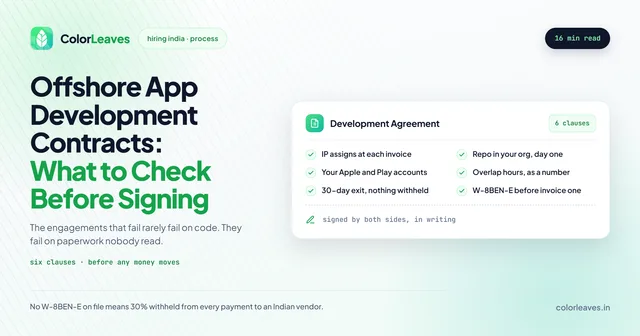
Whichever you pick, tie payments to milestones you can verify rather than to dates on a calendar. A milestone should be an installable build, not a status report, because dates pay out whether or not anything shipped. Twenty to thirty percent up front and the balance against working software is a normal shape, and our contract checklist covers the rest of the commercial terms including what happens if you want out.
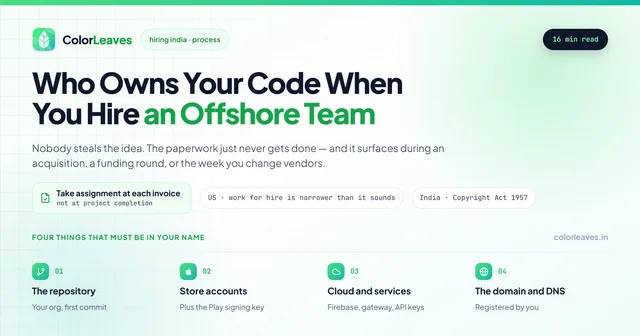
One clause worth adding at the same time. Ask for intellectual property to assign to your company at each invoice rather than at project completion, because assignment on completion means a dispute at month four leaves you owning nothing despite having paid for four months of work.
| Engagement Model | How You Pay | Best For |
|---|---|---|
| Project-based | One fixed price | Clear, well-defined scope |
| Dedicated team | Monthly per developer | Long-term, evolving products |
| Hourly | Per hour worked | Maintenance, unclear scope |
What Actually Drives the Cost
Cost is rarely what decides whether an offshore engagement works. The risks worth knowing first covers what actually does, and who owns your code covers the paperwork that decides what you keep.
Two apps with the same word “app” attached can cost ₹2 Lakhs apart. Here’s what moves the number:
- Feature count and complexity. Real-time chat, payments, GPS, and AI features cost far more than static screens.
- Number of platforms. One platform is cheaper than two. Cross-platform splits the difference.
- Design depth. Template-based UI is cheap; custom animations and multi-role flows aren’t.
- Backend work. A simple API costs a fraction of a scalable, real-time system.
- Developer seniority. Covered above, and it’s the biggest single lever.
- Integrations. Each third-party service (payment gateway, maps, analytics) adds hours.
For a full feature-by-feature and app-type breakdown, see our mobile app development cost guide for India.
In-House vs Outsourcing: The Real Math
This is where a lot of founders get the numbers wrong. Hiring in-house feels cheaper because you only see the salary. The real cost is higher.
A small in-house app team needs at least two developers, a designer, and a QA tester. Salaries for that group run ₹3 Lakhs to ₹5 Lakhs a month. On top of that, add 30 to 40% for benefits, hardware, software licenses, office space, and recruitment. Then factor in the two to three months it takes to hire everyone, during which nothing ships. And you pay all of it whether you have active work or not.
| Cost Factor | In-House Team | Outsourcing to an Agency |
|---|---|---|
| Time to start | 2 to 3 months hiring | 1 to 2 weeks |
| Monthly salary (4 people) | ₹3 to 5 Lakhs | Pay per project or month |
| Overhead | 30 to 40% on top | Built into the rate |
| Cost between projects | You keep paying | Nothing |
| Annual cost (small team) | ₹50 to 80 Lakhs | ₹5 to 15 Lakhs per app |
The takeaway is simple. For a single app or a couple of apps a year, outsourcing wins on cost and speed. In-house only pays off when you have a steady, long-term product that needs daily work for years.
Why Indian (and Pune) Rates Are Lower
Indian developers charge a fraction of what you’d pay in the West, and the quality gap has closed a lot over the past decade. The savings come from lower living and operating costs, not lower skill. A senior developer in Pune writes the same Kotlin or Swift as one in London or Austin.
| Region | Hourly Rate (USD) | Compared to India |
|---|---|---|
| India | $8 to $50 | Baseline |
| Southeast Asia | $20 to $45 | Similar |
| Eastern Europe | $40 to $80 | 2 to 3x higher |
| Western Europe | $60 to $120 | 4 to 6x higher |
| United States | $80 to $150 | 5 to 8x higher |
Within India, Pune runs 30 to 50% cheaper than Bangalore or Mumbai on developer costs, with a talent pool that’s just as deep. The IT hubs in Hinjewadi, Kharadi, and Magarpatta are home to thousands of engineers, many of whom trained at large firms before moving to smaller studios. You get top-tier work without top-tier-city pricing. We’ve looked at this in more detail in our city-by-city cost comparison, including the salary and office costs that drive the gap.
Paying an Indian Team From Abroad
Nobody explains this part until the first invoice is late, and it has a real cost attached.
International wires through your bank are the default and the worst option: two to five working days, 30 to 50 dollars a transfer, and both banks taking a slice of the exchange rate that never appears as a fee. Wise and similar services settle in a day at close to the mid-market rate, and most Indian development firms already hold accounts that accept them. A vendor insisting on wires when cheaper rails exist is either not set up properly or is making margin on the spread.
If you are a US company, your finance team needs a completed W-8BEN-E on file or US rules require withholding 30 percent of every payment, which takes months of correspondence to reclaim. A vendor who has genuinely worked with American clients has this ready before you ask.
Fix the currency in the contract too. Indian firms quote in dollars and book in rupees, so a rate held across a six month project can move several percent on the exchange rate alone. Two lines settle who absorbs it and prevent an awkward conversation in month five.
For a first engagement with a firm you do not know, escrow through the marketplace you found them on is worth the four or five percent, because it removes the largest downside. After a successful project, drop it.
Frequently Asked Questions
How much does it cost to hire a mobile app developer in India?
Freelancers charge ₹500 to ₹2,000 per hour, small agencies charge ₹1,000 to ₹2,500 per hour, and established companies charge ₹1,500 to ₹4,000 per hour. By experience, juniors run ₹500 to ₹1,000, mid-level developers ₹1,000 to ₹2,000, and seniors ₹2,000 to ₹4,000 per hour.
What is the hourly rate of an Indian app developer in 2026?
Most Indian app developers charge between ₹500 and ₹4,000 per hour (roughly $8 to $50). The exact rate depends on experience, the tech stack, and whether you hire a freelancer, an agency, or a senior specialist.
Is it cheaper to hire a freelancer or an app development company?
A freelancer is cheaper per hour and works well for small apps and fixes. A company costs more but covers design, development, testing, and project management, and stays accountable for delivery. For a full app built from scratch, a company is usually the safer value.
How much does a dedicated app development team cost in India?
A dedicated developer in India costs ₹80,000 to ₹5 Lakhs per month depending on seniority. A full small team (two developers, a designer, and QA) on a dedicated basis typically runs ₹3 Lakhs to ₹6 Lakhs a month, far less than running the same team in-house once you add overhead. Our page on hiring dedicated app developers in India covers how that arrangement runs in practice, including notice periods, replacement terms and the overlap hours you should ask for as a number rather than a promise.
What should we agree before the first payment?
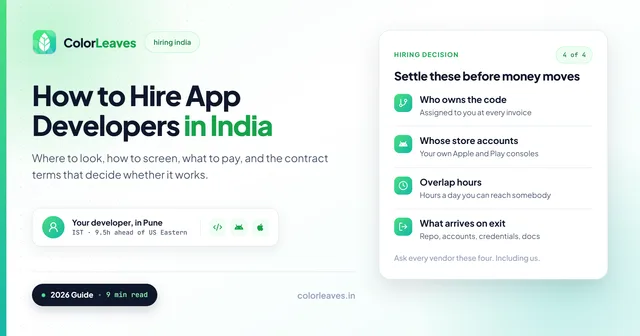
Four things, none of which are about rate. That IP assigns to your company at each invoice. That the repository sits in your organisation from the first commit. That the app publishes under your own store accounts. And what you receive if either side walks away. Our walkthrough of the development process covers what should happen at each stage, so you know what you are buying before you agree what it costs.
Are Indian app developers cheaper than US developers?
Yes, by a wide margin. Indian rates of $8 to $50 per hour compare to $80 to $150 in the US, so you save 60 to 80%. The work is done to the same standards by experienced teams; the difference is local cost of living, not skill.
Should I hire in-house or outsource my app development?
Outsource if you’re building one app or a few apps a year. It’s faster to start and costs ₹5 to 15 Lakhs per app instead of ₹50 to 80 Lakhs a year for an in-house team. Hire in-house only when you have continuous, long-term product work.
Ready to Hire an App Development Team?
Maybe you’ve costed out an in-house team and the numbers don’t add up, or you’ve tried a freelancer and need a full team to take it the rest of the way. Either way, we can give you a clear picture of what your app will cost and who should build it.
At Color Leaves, we’ve delivered 50+ mobile apps from Pune over the past decade across Android, iOS, and cross-platform. We’ll match the right mix of senior and mid-level developers to your project, quote you transparently, and stay on after launch.
Ask us the same questions you would ask anyone else, and put them to the other firms on our list of app development companies in Pune too. Our guide to choosing a development company covers what separates a serious answer from a confident one. If the project is small enough to be a first version rather than a full build, our MVP costing guide is a better starting point than any rate table.
Overseas clients usually want the detail on contracts and logistics rather than day rates. Those pages cover IP assignment, the W-8BEN-E your finance team needs, and how many hours a day you can actually reach us: hybrid app development in India, React Native, Flutter, and native iOS.
Get a free project estimate. Tell us what you’re building, and we’ll send you a detailed proposal with rates, team structure, and timeline.