Online learning in India stopped being a pandemic stopgap a while ago. It’s a habit now. Students in tier 2 and tier 3 cities pay for test prep on their phones, schools run hybrid classes through apps, and working professionals buy skilling courses at 11pm after their kids are asleep. If you’re planning an education app in 2026, two numbers matter first: what it costs to build, and how long it takes.
This guide breaks down education app development costs in India by app type and by feature, with a realistic timeline at the end. The ranges below come from projects we’ve actually shipped, not from a pricing template.
A note on currency, since a good share of the people reading this are budgeting in dollars. At roughly ₹83 to the dollar, ₹8 lakhs is about $9,600 and ₹20 lakhs is about $24,000. Those figures land 50 to 70 percent below what an equivalent US agency quotes, which our cost breakdown for India explains in more detail. If you’re comparing offshore vendors rather than domestic ones, our guide to hiring app developers in India covers what to check before the money moves.
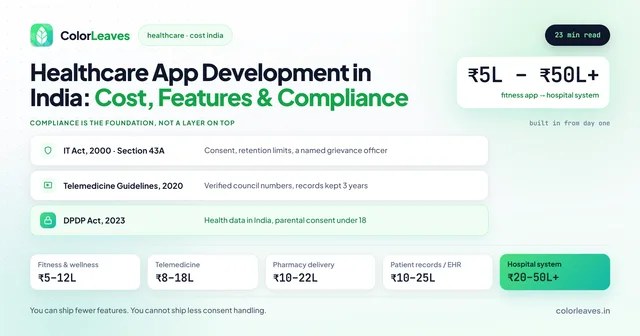
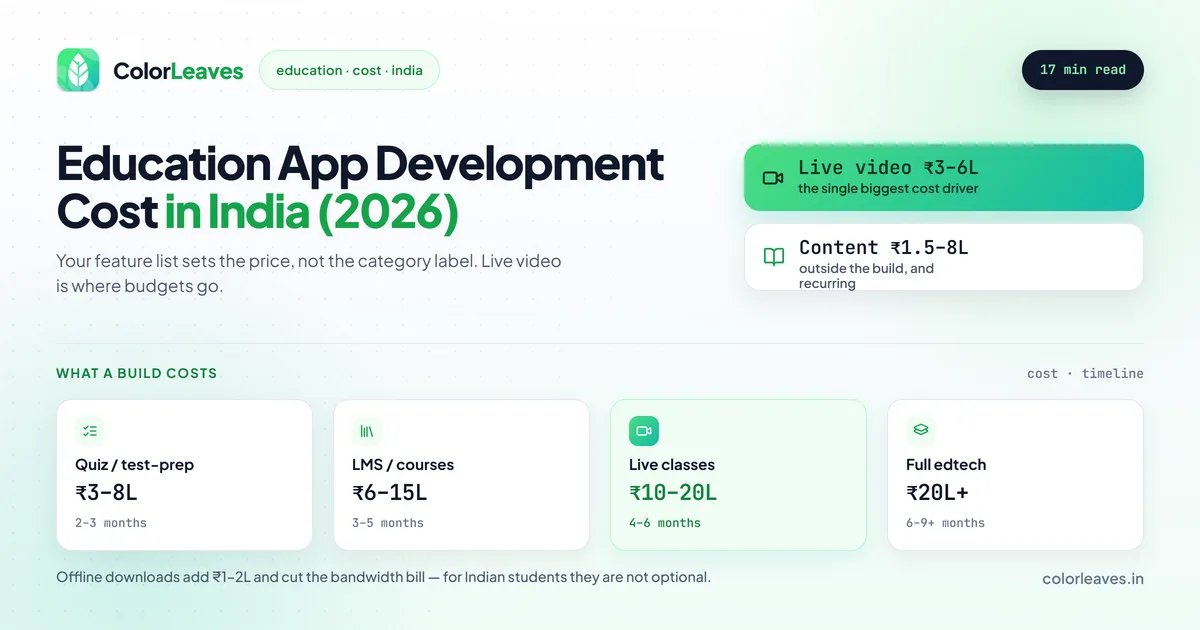
Key Takeaway: An education app in India costs roughly ₹3 to 8 lakhs for a quiz or test-prep app, ₹6 to 15 lakhs for an LMS or course platform, ₹10 to 20 lakhs for a live class platform, and ₹20 lakhs and up for a full edtech platform like BYJU’s or Unacademy. Your feature list, not the category label, sets the final price.
Types of Education Apps and What They Cost
Each type maps to a different audience and a very different engineering load. A timed quiz app and a live class platform might both be “education apps,” but they share almost nothing under the hood. Here’s how the four common models compare.
Quiz and test-prep app. Built around NEET, JEE, UPSC, CAT, or banking exam prep. The core is a question bank, mock tests, timed quizzes, instant scoring, and leaderboards. Most of the work sits in content delivery and result analysis, so this is the cheapest category to build. Expect ₹3 to 8 lakhs.
LMS or course platform. Think Udemy-style. Recorded video courses organised into modules, student dashboards, progress tracking, certificates, and an instructor panel for uploads. More moving parts than a quiz app because you’re managing video, enrolment, and payments together. ₹6 to 15 lakhs.
Live class platform. Real-time teaching with video, an interactive whiteboard, chat, hand-raise, attendance, and doubt-solving. The streaming infrastructure is what pushes the price up. You’re paying for low-latency video that works on a patchy 4G connection in a small town. ₹10 to 20 lakhs.
Full edtech platform. Everything above in one product. Live plus recorded classes, adaptive tests, AI-driven recommendations, a parent app, payments, subscriptions, and a heavy admin backend. This is the BYJU’s and Unacademy tier. ₹20 lakhs and up, and the “up” can go a long way depending on scale.
| App Type | Complexity | Estimated Cost | Timeline |
|---|---|---|---|
| Quiz / Test-Prep | Low-Medium | ₹3 to 8 lakhs | 2 to 3 months |
| LMS / Course Platform | Medium | ₹6 to 15 lakhs | 3 to 5 months |
| Live Class Platform | Medium-High | ₹10 to 20 lakhs | 4 to 6 months |
| Full Edtech Platform | High | ₹20 lakhs+ | 6 to 9+ months |
What Each Feature Actually Costs
The most useful thing I can hand you is a per-feature breakdown. It lets you build an MVP on a budget and add the expensive pieces later. For broader context on how features add up across any app, our complete app development cost breakdown goes deeper.
| Feature | Cost Range | Notes |
|---|---|---|
| Live video classes | ₹3 to 6 lakhs | Real-time streaming, whiteboard, chat, attendance. The single biggest cost driver |
| Recorded content & streaming | ₹1.5 to 3 lakhs | Video hosting, adaptive bitrate, secure playback to stop piracy |
| Assessments & quizzes | ₹1 to 2.5 lakhs | Question banks, timed tests, auto-grading, detailed result analysis |
| Progress tracking | ₹60K to 1.5 lakhs | Course completion, scores over time, streaks, personalised dashboards |
| Gamification | ₹50K to 1.5 lakhs | Points, badges, leaderboards, rewards to keep students coming back |
| Payments & subscriptions | ₹1 to 2 lakhs | UPI, cards, EMI, recurring plans, coupon codes, free trials |
| SCORM / content packaging | ₹1 to 2.5 lakhs | Import standard e-learning packages, useful for corporate and institutional clients |
A few notes on these numbers. Live video is where budgets blow up, because you’re either integrating a paid SDK (Agora, 100ms, Zoom) or building on top of WebRTC, and both carry ongoing per-minute costs. SCORM support is something most consumer apps skip, but if you’re selling to schools, colleges, or corporate L&D teams, it’s often a hard requirement. Bundle these features into one project and you usually save 15 to 20 percent compared to the line-item total, because the backend, auth, and infrastructure get shared.
Cost by Build Complexity
Here’s the bigger picture, the table most founders ask for in the first call.
| Category | Basic (Quiz/MVP) | Mid-Level (LMS) | Advanced (Live/Edtech) |
|---|---|---|---|
| Scope | Single subject, tests, scoring | Multi-course catalog, recorded video | Live classes, AI, multi-role |
| Platforms | Android + iOS (cross-platform) | Android + iOS (cross-platform) | Android + iOS + Web + admin |
| Key Features | Quizzes, leaderboards, basic profile | Courses, payments, progress, certificates | Live video, doubt-solving, parent app, analytics |
| Backend | Standard APIs | Scalable APIs, video pipeline | Real-time streaming, microservices |
| Cost Range | ₹3 to 8 lakhs | ₹6 to 15 lakhs | ₹15 to 30 lakhs+ |
| Timeline | 2 to 3 months | 3 to 5 months | 6 to 9+ months |
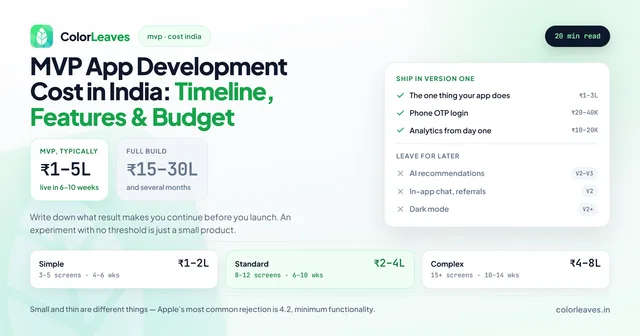
My honest advice to most first-time edtech founders: start at the basic or mid tier and prove demand before you spend on live video. A test-prep app with a sharp question bank and clean analytics can validate your market for under ₹8 lakhs. Once students are paying and retention looks healthy, fund the live class engine in version 2. You’ll build it better the second time anyway, because you’ll know what your users actually do. Our MVP costing guide covers how to scope that first version so it proves something rather than just existing.
The Cost Nobody Budgets For: Content
Here is the number that catches edtech founders, and it is frequently larger than the app.
An app with no content is a shell. Somebody has to write the questions, record the lessons, design the curriculum and check the answers. For a test-prep product, a usable question bank means 3,000 to 10,000 questions with worked solutions, which at ₹30 to ₹100 per question with subject-expert review lands somewhere between ₹1.5 and ₹8 lakhs. That is on top of everything in the tables above.
Recorded video is worse. Studio-quality lessons run ₹8,000 to ₹25,000 per finished hour once you count the teacher, the recording, the editing and the graphics. A 40 hour course is therefore ₹3 to ₹10 lakhs of production before a single student watches it. Teams that shoot on a phone in a spare room save most of that and pay for it in completion rates.
Two consequences worth planning around. First, content is a recurring cost rather than a one-off, because syllabuses change and last year’s questions get stale. Second, it does not scale down. You can ship a smaller app; you cannot ship half a syllabus and expect anyone to pay for it.
If you’re licensing content from somebody else, settle ownership before you build. Who owns the recordings, what happens to them if the relationship ends, and whether you can keep serving them to students who already paid. Those are the same questions we ask about code ownership, and they matter more here because content is usually the more valuable asset.
What It Costs to Run, Every Month
The build is one number. Edtech has unusually high running costs, and unit economics is where most of these products actually fail.
Video streaming and bandwidth. The largest line by a distance. Live class SDKs like Agora or 100ms charge per participant-minute, typically ₹0.30 to ₹1.20 depending on volume and resolution. A hundred students in a one hour class is 6,000 participant-minutes, so ₹1,800 to ₹7,200 for that single class. Run four classes a day and the monthly figure is real money before you have paid anyone.
Recorded video delivery. CDN bandwidth runs ₹1 to ₹8 per GB depending on provider and region. A one hour lesson at reasonable quality is roughly 500MB, so a thousand students watching ten hours each is around 5TB, which is ₹5,000 to ₹40,000 a month. Adaptive bitrate reduces this substantially and is worth the engineering.
Storage, servers and services. Video storage, database, push notifications, SMS for OTP, payment gateway fees at around 2 percent. For a mid-sized platform, budget ₹15,000 to ₹60,000 monthly.
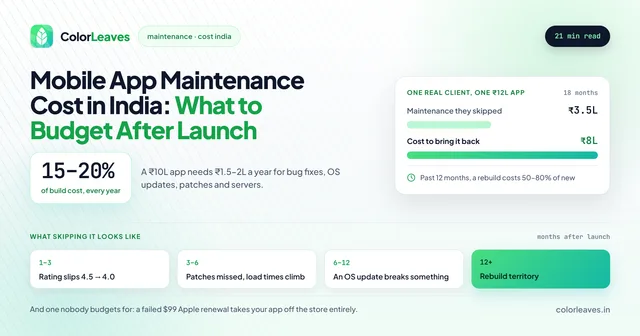
Maintenance. Both stores change their requirements annually and libraries need updating regardless. Budget 15 to 20 percent of the original build cost per year, which our app maintenance cost guide breaks down, or arrange ongoing support with a defined scope rather than calling somebody when it breaks.
Price your subscription against these numbers rather than against what competitors charge. A course priced at ₹499 that costs you ₹300 a month in streaming for an engaged student is not a business, and plenty of edtech founders discover this at scale rather than on a spreadsheet.
The 30 Percent You Did Not Plan For
Courses are digital content, and digital content sold inside an iOS app must go through Apple’s in-app purchase system. Apple takes 30 percent, or 15 percent under the Small Business Program if you earn under a million dollars a year. Google Play applies broadly similar terms.
That is not a rounding error on a ₹5,000 course. It is ₹1,500, and it comes off the top before your streaming costs.
Routing students to your website to pay, then unlocking the content in the app, is the obvious workaround and it is a rejection under guideline 3.1.1. Apple’s rules here have shifted after various antitrust rulings and continue to shift, so check the current position rather than trusting any blog post, this one included.
Live tutoring is more interesting, because a live session with a human is arguably a real-world service rather than digital content, which would put it outside in-app purchase entirely. That distinction is worth resolving before you build the payment flow, since rebuilding checkout after a rejection is a large piece of work. Our publishing cost breakdown covers the store fees alongside this, and the rejection rate data shows how often submissions come back.
Don’t Skip Offline Access
This is the feature that separates apps built for India from apps built for a demo. A large chunk of your users will be on slow or unreliable connections, in hostels, in villages, on trains. If your app only works on strong WiFi, you’ve quietly excluded half your market.
Offline support means students can download recorded lessons, PDFs, and quizzes, then study without a live connection and sync their progress later. It adds roughly ₹1 to 2 lakhs to the build because you’re handling local storage, encryption (so downloads can’t be copied off the device), and conflict resolution when data syncs back. For low-bandwidth users it’s not a nice-to-have. It’s the reason they keep the app installed.
It also cuts your bandwidth bill, since a lesson downloaded once and watched three times is a third of the CDN cost. The feature pays for itself faster than most.
The same logic applies to hardware. Students you most want to reach are frequently on the cheapest handsets in the market, with 3 or 4GB of RAM and a screen that has seen better days. Video playback and a scrolling question list are exactly the workloads that fall over there, which is why testing across real Android devices matters more for education than for almost any other category. Get builds onto student phones early through a Play internal testing track rather than finding out from reviews.
Children’s Data, Which Has Teeth Now
If your users are under 18, this is not a footnote.
India’s Digital Personal Data Protection Act requires verifiable parental consent for processing children’s data and prohibits behavioural advertising directed at them. That is a design constraint, not a privacy policy paragraph, and it shapes onboarding, analytics and how you monetise.
The US brings COPPA for under-13s, with meaningful penalties. Apple’s Kids category is stricter than either: no third-party analytics, no third-party advertising, and no external links without a parental gate. Opting into that category is a real engineering commitment, so decide deliberately rather than ticking it because your users are students.
Schools and institutions ask harder questions again. Expect a procurement process wanting to know where data sits, who can access it, and what happens at contract end. Those answers should be in your architecture from the start, and they are the same contract terms worth settling with your development partner too.
Development Timeline
Knowing the timeline lets you plan your launch, your content production, and your marketing around it. For a phase-by-phase view of how we run a build, read our mobile app development timeline guide.
| App Type | Discovery & Design | Development | Testing & QA | Total |
|---|---|---|---|---|
| Quiz / Test-Prep | 2 to 3 weeks | 5 to 8 weeks | 1 to 2 weeks | 2 to 3 months |
| LMS / Course Platform | 3 to 4 weeks | 8 to 14 weeks | 2 to 3 weeks | 3 to 5 months |
| Live Class Platform | 4 to 5 weeks | 12 to 18 weeks | 3 to 4 weeks | 4 to 6 months |
| Full Edtech Platform | 5 to 7 weeks | 18 to 28 weeks | 4 to 6 weeks | 6 to 9+ months |
These assume a dedicated team working full-time. Add a 20 to 30 percent buffer for content integration, revisions, and the scope creep that hits every edtech project once stakeholders start watching real students use it. Video features in particular eat testing time, because you have to check playback across cheap Android phones, weak networks, and different screen sizes.
Building Your Education App from Pune
If you’re comparing cities for your build, Pune is worth a serious look. Development costs here run 40 to 60 percent lower than Bangalore or Mumbai, and the quality holds up. Our comparison of Pune, Bangalore and Mumbai rates sets out where that difference actually comes from. The talent pool is deep across mobile, video streaming, and backend work, with engineers who’ve come out of Infosys, TCS, and Persistent before joining smaller product teams.
At Color Leaves, we’ve spent over a decade building mobile apps from Pune, and we offer dedicated education app development services covering test-prep apps, LMS platforms, and live class systems. We’ve handled the messy parts (video that survives a 4G drop, offline downloads, payment retries) so you don’t learn them the expensive way. Take a look at our portfolio to see past work, including StockGenie, where handling real-time data over patchy connections was most of the project.
If you’d rather compare a few firms before deciding, our list of app development companies in Pune includes our competitors, and how to choose a development company covers what to ask all of them.
Frequently Asked Questions
How much does it cost to make an education app in India?
A quiz or test-prep app costs ₹3 to 8 lakhs. An LMS or course platform runs ₹6 to 15 lakhs. A live class platform with real-time video lands at ₹10 to 20 lakhs, and a full edtech platform starts around ₹20 lakhs. The exact figure depends on your feature list, especially whether you need live video. See our detailed app cost guide for more.
What makes live class apps so much more expensive?
Real-time video. You’re either paying for a streaming SDK with per-minute charges or building on WebRTC, and both demand serious backend work to keep latency low on weak connections. Live classes also need a whiteboard, chat, attendance, and recording, so the feature alone often costs ₹3 to 6 lakhs before you add anything else.
How long does it take to build an e-learning app?
A test-prep app takes 2 to 3 months. An LMS takes 3 to 5 months. A live class or full edtech platform takes 6 to 9 months or more. These windows include design, development, and testing. Our timeline guide breaks down each phase.
Do I need offline access in my education app?
For the Indian market, yes. A big share of students study on slow or unreliable networks. Offline downloads for recorded lessons, notes, and quizzes keep your app usable for them, and it costs about ₹1 to 2 lakhs to add. Skipping it quietly shrinks your reachable audience.
What is SCORM and do I need it?
SCORM is a standard format for packaging e-learning content so it works across different platforms. Consumer apps usually don’t need it. If you’re selling to schools, universities, or corporate training teams, it’s often required, and supporting it adds roughly ₹1 to 2.5 lakhs to the build.
Can I launch with a smaller budget and scale later?
Absolutely, and most successful edtech founders do exactly that. Start with a focused MVP (a strong test-prep app or a recorded-course LMS) for ₹6 to 10 lakhs, get paying users, then reinvest in live classes and AI features once you’ve proven the market. You’ll build the expensive parts smarter the second time.
Planning Your Education App?
Maybe you’re an educator turning your coaching into an app, or a startup chasing the next big edtech category. Either way, the trick is spending on the right features in the right order, not building everything at once.
We’ve delivered 50+ mobile apps over the past decade, and we’ll help you scope an MVP that fits your budget, pick a video setup that works on real Indian networks, and ship something students actually open every day. Get a free project estimate and we’ll send back a detailed proposal with feature-wise pricing and a timeline you can plan around.
Choosing the Build Route
Learning apps live or die on the interface. Video playback, progress tracking, quizzes and offline downloads all have to feel smooth on cheap Android hardware as well as on a new iPhone, which pushes most ed-tech products toward cross-platform. Getting that right is a UI and UX problem before it is an engineering one, because a course a student cannot navigate is a course they do not finish.
Flutter often wins here because it renders its own widgets, so a design system holds up identically across a wide device range. React Native is the better call if you already employ React web engineers, since your own team can then review the work. The cross-platform comparison covers the decision, and Flutter versus React Native goes deeper on the tradeoffs.
Whichever way you go, get the process right around it. Our step by step guide to building an app covers the sequence, and what it costs to hire developers in India covers the rate bands if you’re staffing a team rather than buying a build.